Visiting the temples of Angkor Wat is an experience everyone must do when in Cambodia. It is not surprising that the temples are considered the 8th Wonder of the World.

What are the temples of Angkor Wat?
Angkor Wat is the name of the most famous and well preserved temple in Cambodia. It is also the name for the collective group of temples within that area, as well as a UNESCO heritage site.
Where are the temples of Angkor Wat?
The temples of Angkor Wat are located in central Cambodia, just outside of Siem Reap. From the Siem Reap city center it is roughly 30 minutes to Angkor. However there are more temples in the area than just around Angkor Wat and Angkor Thom. Further temples are 45 to 60 minutes outside the city center.
History of Angkor
Angkor was the capital of the Khmer Empire from the 800s to the 1400s. After this the empire moved south to modern day Phnom Penh. The temples of Angkor were built at the direction of the Khmer kings from the mid 800s into the 1300s. These are a mix of royal temples and residences. The Angkor area has over 70 major temples and up to a 1000 minor temples scattered throughout the area. Not all temples were completed. There’s a story of a temple that was hit by lighting during construction. This was considered a bad omen, and the temple was abandoned.
During its peak Angkor was one of the largest cities in the world, with a population of 700,000 – 900,000 people. p to the present time, Angkor Wat is still the largest religious monument in the world.
The Angkor region was largely abandoned in the 1400s, and for centuries the jungle took over the temples. In the late 1800s, the French arrived to colonize Cambodia and Vietnam. During this time French explorers found the temples and set in motion the renovations that were critical to allowing visitors the opportunity to see the temples. Restoration has continued to this day through efforts with the Cambodian government along with other government support from India and Japan.
One of the most interesting facts about the history of Angkor is that throughout the centuries the religion changed many times. Early on, the rulers and people were Hindu, but transitioned to Mahayana Buddhism under king Javaraman 7. When king Javaraman 8 took over, he was Hindu and set about destroying images of Buddha at the existing temples and converting them to temples of Shiva. This is why there are limited statues or images of Buddha at the temples today. Any that you see have all been added during restoration efforts. In the 1200s religion in Cambodia transitioned to Theravada Buddhism, and is still the predominant religion of Cambodia.

How to get to the temples
To get to the temples of Angkor, you have a few options. First, you can join in a group or private tour, which will include transportation to the temples. If you join a tour the company will pick you up at your hotel, or a designated pick up/drop off location. Accordingly, this will be the same process if you have a multi-day tour.
The second option is to order a car or tuktuk to either drop you off or drive you for the day. You can either order one from Grab, which I recommend, or negotiate with the tuktuk drivers on the street. If you get dropped off, see if your driver will pick you up at a designated time or location. The further out you are, the longer it will take to get a ride back to the city, especially at the end of the day. Many drivers are willing to stay while you explore.
Finally, you can bike to the temples. The route from Siem Reap to Angkor is very flat, and there are bike paths most of the way to Angkor. Overall, this is a fun and unique way to explore and travel between the temples.
What to wear at the Temples of Angkor
When entering the temple sites, you must have your shoulders covered and pants or skirts that extend to your knees. Outside of the checkpoints you can wear a tank top or sleeveless shirt, but once you enter the temple boundaries you need to be covered. Be sure to plan ahead and come prepared with the appropriate coverings, or you will not be allowed into the sites.
While at the temples you will climb stairs, walk long distances, and through uneven terrain. Make sure to wear comfortable walking shoes!


How much does it cost to visit Angkor Wat?
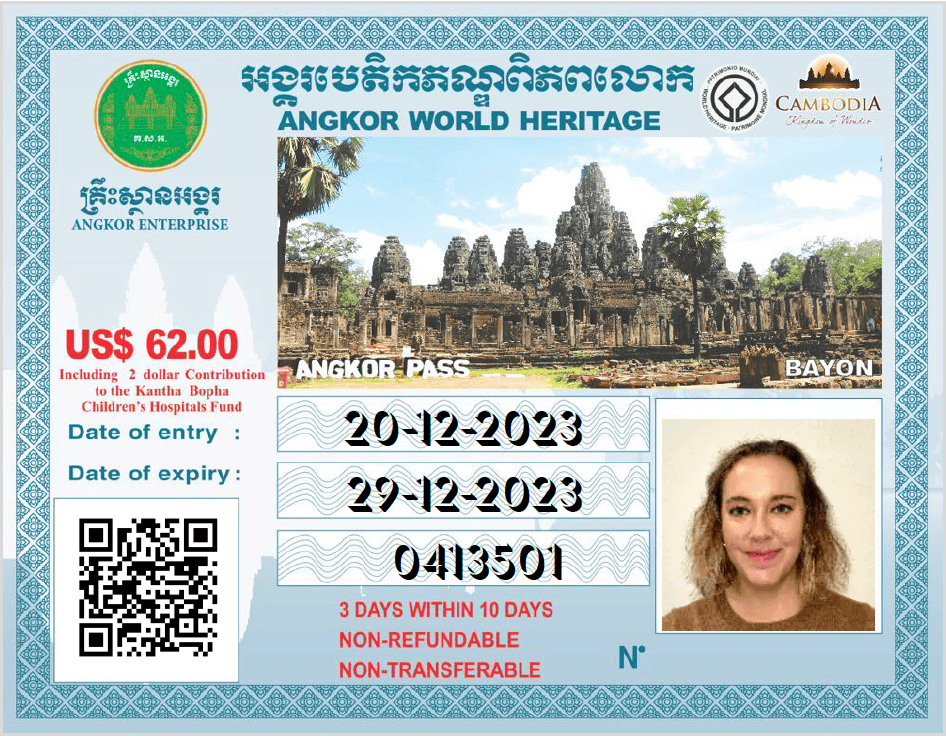
In order to visit the temples of Angkor Wat, you will need to purchase a 1, 3 or 7 day pass to enter regardless if you go alone or with a tour guide/group. To decide whether you should book a tour or explore on your own read Everything you need to know: Booking a Tour of Angkor Wat
- 1 Day – $37
- 3 Day – $62
- 7 Day – $72
I strongly recommend you get at least the 3 day pass. You will need at least 2 days to really have time to explore the top temples.
You can purchase your pass electronically ahead of your visit, rather than getting it at the gated checkpoint. Make sure you have a passport photo available, as a headshot is required in addition to your application.
Once you have your pass, save it to your photos for quick access. You will need to show your pass at all major temple entrances. In the event that you do not have data or working cell service, a photo is the easiest for showing you pass.
Purchase your passes through the official website.
What are the visiting hours?
Most of Angkor is open from 7:30am to 5:30pm year round, however some of the temples are open early for sunrise and/or sunset visits.
- Angkor Wat and Sras Srang are open from 5:30am – 5:30pm
- Pre Rup and Bakheng are open from 5:30am to 7:00pm
Keep in mind, that the middle of the day will be very hot with intense sun, therefore early morning or late afternoon visits are more pleasant. Because of this, temples are also typically less busy in the late afternoon.
Must See Temples of Angkor
Angkor Wat
Angkor Wat is the most famous and impressive of all the temples in the Angkor area. Built in the 1100s it served as the capital of the Khmer empire at the time and the king’s palace and temple. This temple is recognizable for the five iconic towers. A central tower, with four shorter towers surrounding it in a square pattern.
There are two small reflecting pools in front of the temple where you can get beautiful pictures of the temple. Pro tip, if you go later in the day, you will get the best light and least amount of people right before closing.

Bayon (Angkor Thom)
Angkor Thom is the ancient city of Angkor. Within the city you will find many different temples and monument remnants. The south gate has a beautiful bridge leading into the walled city with statues of the gods on one side and demons on the other.
The most prominent and impressive of the temples in Angkor Thom is the temple of Bayon. Known as the temple with the faces. This is obvious when you visit, because there are over 50 towers (including a larger central tower) that have huge carved faces visible from all four sides.
Aside from the impressive scale of the facial carvings, there are highly detailed frieze carvings all along the exterior walls surrounding Bayon.

Ta Prohm
Today this temple is best known for being in the “Tomb Raider” movie. Unlike many of the other temples this one is famous not for the architecture, but for the way nature has taken over the site.
After the temple was abandoned in the 1400s, the jungle started to take over. Seeds of strangler figs and silk-cotton trees made their way through the temples into the group to sprout and grow over the centuries. Here you will find huge trees that have roots overtaking the temple walls.
The tree shown in “Tomb Raider” is the most famous, but you will find dozens more throughout the site. With a mix of giant roots the size of tree trunks, and others with more web-like configurations. Undoubtedly, this is a unique and must see location.


Banteay Srei
Banteay Srei is one of the earlier temples of the area, built in the 10th century. This temple is made from red sandstone and filled on every wall and column with highly detailed and ornate carvings.

Preah Khan
Preah Khan is one of the larger temples in the Angkor area, but not very well restored compared to the monuments of Angkor Wat or Angkor Thom. Like many of the other temples, this was erected as a Buddhist temple, but was converted to a Hindu temple, with the Buddhist imagery being destroyed in the process. The temple has many standard features including a barrier wall surrounding the grounds, and the typical beehive columns, always in odd numbers.
There are many buildings within the fortified walls, but the main structure has a maze-like quality. You’ll see many carvings here as well, but not as detailed or well preserved as Banteay Srei.


Neak Poan
This temple is a small temple, which in comparison to some of the others is not quite as impressive in stature. However, this temple is unique in that it is located on a small island at the center of a man made lake. To reach the temple there is a walkway that connects to the island, and you get stunning views of bright pink water lilies. The walk itself is worth the trip to the temple.


Additional Posts on Cambodia
- Everything you need to know: Booking a Tour of Angkor Wat
- Helpful things to know before visiting Cambodia

I’m a Seattle based traveler that has been to over 40 countries and all 7 continents. I am a frequent solo traveler, visiting over 20 countries solo.
I consider myself a mid-budget travel generalist, meaning I like to do a little bit of everything from adventure activities and museums, to beach days and historic walking tours. Every now and then I’ll splurge on premium cabins or high end hotels, but most of the time I’m economy (probably Comfort+) and finding deals for well rated hotels.
